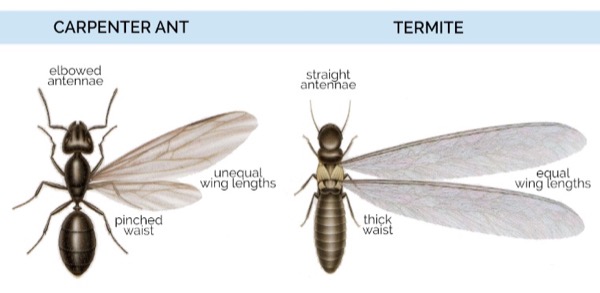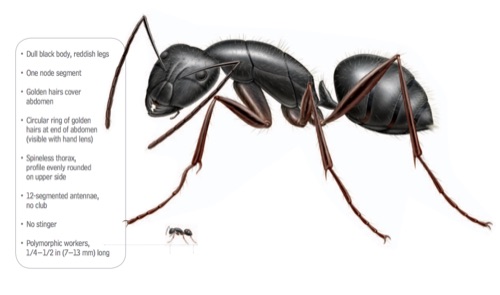




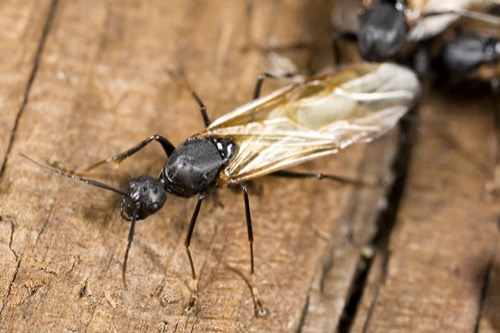
Identification - Carpenter Ants are often called the "Big Black Ant" although some subspecies may be reddish-brown in color.
- Size may range from ¼ inch to ¾ inch.
- The ants you see may be either wingless workers or winged reproductive ants from the colony.
Behavior
As carpenter ants bore their nests, they leave behind several piles of fibrous, finely shredded sawdust-like material called "frass". Faint clicking or rustling sounds within walls may also be an indication of the presence of Carpenter Ants. Carpenter Ants form tight, close trails that can be traced to the nesting areas. Trails are most often found along carpet edges, door frames, fence tops, etc.
Keep in mind that an occasional ant does not indicate the presence of a nest in your home; scouts from outside nests will travel up to the length of a football field to find food. Continuous or numerous ants are a better sign of nesting.
Habitat
Carpenter ants are usually found in moist, damp areas. Homes built in densely wooded areas, or in low, shady places are particularly susceptible to Carpenter ant invasion. Favorite indoor nesting spots include around sinks or other moist places near kitchens and bathrooms.
Feeding Habits
Carpenter ants will forage for food at anytime, but are at highest activity during nighttime hours. Inside homes, carpenter ants are most often attracted to sweet foods such as fruits, juices, syrups, jellies, and savory foods such as meat, grease and fat.
Life Cycle
Winged male and female Carpenter Ants mate between March and July. After mating, the males die, leaving the fertilized female to lay her eggs (about 15 to 20 at a time) in small wood cavities. About 24 days later, the eggs will hatch, followed by a 21-day larval stage and 21 day pupal stage. In total, the life cycle of the Carpenter Ant is about 66 days from egg to adult. Colder weather may lengthen the process up to 10 months.
Damage
The most common damage left behind by carpenter ants is wood damage. Carpenter Ant wood damage (as opposed to termite damage) is characterized by smooth, clean galleries and small windows or slit-like openings. These slits acts as "garbage chutes" used to dispose of frass and other materials. Wood damage is often not visible unless wall or ceiling cavities are actually opened.
Basic Control Methods
- If you suspect the carpenter ants are entering from an outdoor location, try a Perimeter Treatment with Suspend SC or Talstar.
- Apply Delta or Drione Dust inside walls and other voids where Carpenter ants are nesting.
- When you know exactly where a carpenter ant colony is located, a localized spot treatment with a product like Bora-Care will quickly eliminate the infestation.
- The most effective method used to get rid of carpenter ants is baiting. Apply a 2 to 4 foot band of bait such as Niban Granular Bait or Advance Carpenter Ant Bait around the perimeter of your home and around the base of trees, firewood piles, stumps, or other places carpenter ants might nest.
View all Carpenter Ant Control Products Carpenter Ant Kits Carpenter Ant Kit #1 Carpenter Ant Kit #2
Related Articles How To Get Rid of Carpenter Ants Carpenter Ant Control Carpenter Ant Baiting Tips Difference Between Termites and Carpenter Ants Carpenter Ant Inspection and Damage Carpenter Ants Identification and Biology
|