



view cart  my account  pest control help  
   
  Pick a pest:
Ants
Bed Bugs
Birds
Boxelder Bugs
Carpenter Bees
Carpet Beetles
Centipedes
Clothes Moths
Crickets
Drain Flies
Earwigs
Fire Ants
Fleas
Flies
Fruit Flies
Ground Hogs
Grubs
Lady Bugs
Millipedes
Moles
Mosquitoes
Opossums
Pantry Beetles
Pantry Moths
Pantry Pests
Powderpost Beetles
Raccoons
Rats & Mice
Roaches
Scorpions
Silverfish
Skunks
Snails and Slugs
Snakes
Spiders
Springtails
Squirrels
Stink Bugs
Termites
Wasps & Hornets
Yellow Jackets

Tools and Sprayers
General Pest Control
Natural & Organic
Odor Control
Lawn & Garden
Herbicides and Generic Roundup
Maxforce Products
Talstar Products
Diazinon
Do It Yourself Pest Control
Pest Control
Active Ingredients
All Products
Kits


Orders, Shipping & Returns
Privacy & Security
Disclaimer
Contact Us
All products
Site Map
Articles
Newsletter
Home » Articles » Bees, Wasps & Hornets » Carpenter Bees Identification and Biology

Carpenter Bees Identification and Biology

By DoMyOwnPestControl.com staff


Email article Print article


Physical Appearance

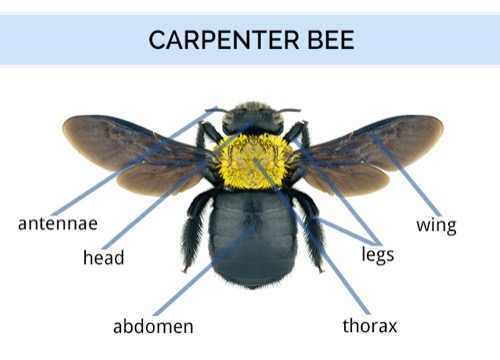
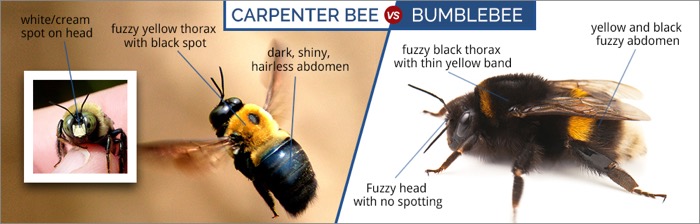
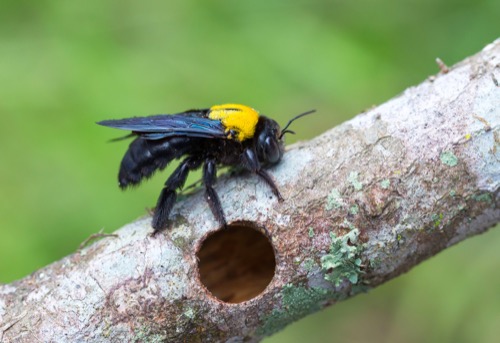
Carpenter bees may be identified by a blue-black, green, or purple metallic sheen and hairless abdomen. They may also be yellow and black like the traditinal bumble bee, but what sets the carpenter bee apart is its large size. The carpenter bee is typically ½" to 1" long.


Behavior

Carpenter bees are solitary (not social) wood-burrowing insects. The female bores long tunnels (approx ½ inch in diameter) into dry, exposed wood and then divide these tunnels into galleries (or cells) where individual larvae will develop. Carpenter bee galleries may be anywhere from 4 inches to 12 inches for a gallery colonzied by a single bee, to nearly 10 feet long in a gallery colonized by several carpenter bees in succession. While the female tends the nest, the male carpenter bee hovers around the gallery entrance, chasing anyghing that comes near. Males lack a stinger and are harmless. The female carpenter bee does have a stinger, but rarely uses it. Nest openings are usually found on the underside of wood surfaces.


Life Cycle

The female carpenter bee lays eggs in individual galleries in the Spring. By early summer, larvae and pupae develop in the closed cells, a process that takes about 3 months. Adult carpenter bees emerge from the cells in late summer, and return to the same tunnels to overwinter the cold winter months. The following spring, each new adult bee will mate, and the new females will make a nest of her own, completing the cycle.


Signs of Infestation

  • Half-inch round holes in dry, unfinished wood, with piles of sawdust underneath
  • Dirty yellow streaks of fecal matter staining the wood below the hole
  • If a given hole is presently occupied, you will likely find the male buzzing around you when you are near that hole
  • A single pair of carpenter bees (male and female) occupies each nest, however, several pairs of carpenter bees may build separate nests in the same wooden structure.


Basic Prevention & Control:

1) Prevent infestation of wood as much as possible by painting and varnishing unfinished wood suseptible to infestation.

2) Apply a liquid residual in early spring, when carpenter bees are most active looking for a nesting site.  Cyper WP and Cyonara 9.7 both very effective residuals that can applied directly to wood surfaces with a 1 gallon sprayer.

3) Apply a residual dust, such as Delta Dust, deep into active galleries using a centrobulb duster. This dust will remains effective for several months so that when the carpenter bee larvae develop and emerge as new adults, they will pass through the dust and die.

4) Seal off holes with wood putty or plastic plugs after all bees have died, to prevent future reinfestatin.


*Save money with one of our Carpenter Bee Kits:
Carpenter Bee Kit with Cyper WP
Carpenter Bee Kit with Cyonara 9.7


View more Carpenter Bee Control Products

For more detailed information on Carpenter Bee control, see How To Get Rid of Carpenter Bees


Customers who read this article also bought:


We only sell the most effective products available-- the same products pest control companies use.

Can't find the product you are looking for?  E-mail us and we'll get it for you!


0 items


Disclaimer | Shipping & Returns | Privacy Notice


*NOTE: Free Ground Shipping is only for orders to the lower 48 United States.
Best Price Guarantee: We strive to keep the lowest possible prices on the Internet.
If you find otherwise (price must include tax and shipping) then email us. We'll match
or beat the price. We'll do what it takes to earn your business!

Do My Own Pest Control
5730 Oakbrook Pkwy, STE 130 Norcross, GA 30093
Call Toll Free: 1-866-581-PEST (M-F 9am-5pm EST)

All trademarks and logos are property of their respective owners.
©2004-2009 DoMyOwnPestControl.com. All Rights Reserved.