
Buy 2 or more: $32.48 each
Have a Question? Ask Our Pros!
Same as Merit 75 but for much less!
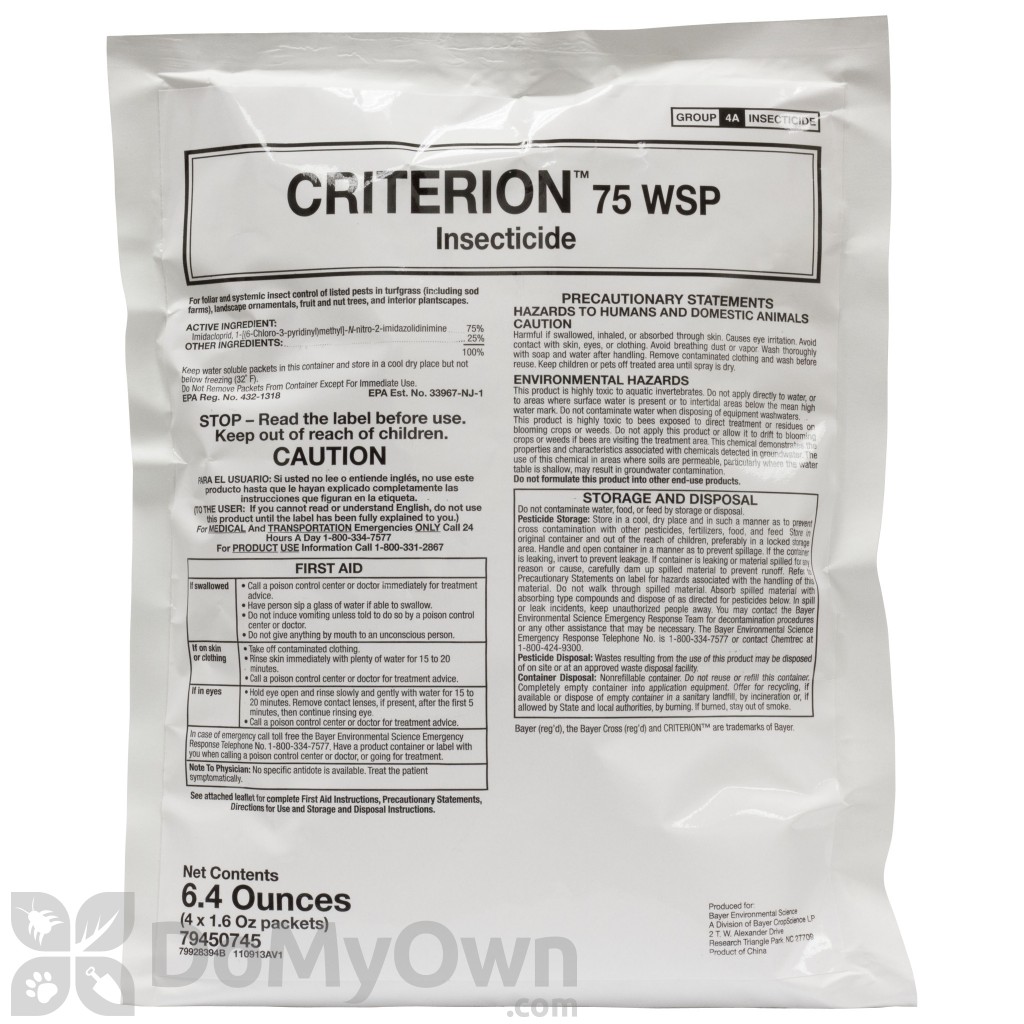
Criterion 75 WSP contains 75% Imidacloprid, a systemic insecticide for controlling insect pests on sod, lawns, landscape areas and ornamental trees and shrubs. In addition to protecting the health of turf and landscape ornamentals from within the plant, Criterion 75 WSP provides fast knock-down, broad-spectrum control, and long lasting grub and insect control with preventative and curative properties. Criterion 75 contains imidacloprid for consistent performance and flexible application timing.
There are 4 x 1.6 oz water soluble packets in each envelope.
Product Documents
| Active Ingredient | Imidacloprid 75% |
|---|---|
| Target pests |
Aphids, Billbugs, Chinch Bugs, Crane Flies, Japanese Beetles, Thrips, White Grubs and others * See label for complete list |
| For use in |
Foliar & Systemic Control; Turf-grass, Landscape & Ornamental Trees and Shrubs * See label for complete list |
| Application | * See label for complete application instructions |
| Yield | 4 x 1.6 oz. Water Soluble Packets in each Envelope |
| Formulation |
Professional Product Group 4A Insecticide |
| NOT FOR SALE TO | CT, NY (Restricted To Licensed Applicators Only) |
| Shipping Weight | 0.46 lbs |
| Manufacturer | Envu (Formerly Bayer) |
| UPC | 01007857401397 |
| EPA Registration | 432-1318 |
Criterion 75 water soluble packet (WSP) is a liquid insecticide concentrate which can be used at very low rates and applied as a foliar spray, soil broadcast spray, soil injection or soil drench to control grubs, weevils, and other soil and turf inhabiting pests. Soil applications are taken up by plant, ornamental, and tree roots into twigs, stems, and foliage. Criterion 75 WSP includes detailed instructions for application to turfgrass, ornamentals, trees, shrubs, flowers, groundcovers, and in and around commercial or residential buildings. Most applications of Criterion 75 Systemic Insecticide require the use of a large tank sprayer. There are 4 x 1.6 oz water soluable packets in each envelope.
The coverage area of 1 envelope of Criterion 75 WSP will depend entirely on the type of pest you are treating and the area that is being treated. Here are some general guidelines:

Great Alternative to higher priced Merit 75 WSP
By Sheryl on 11/04/2010
 Verified Purchase
Product worked in EXACTLY the same manner as the higher priced Merit 75 WSP. Took care of my ficus shrubs, that were infested with white fly. Two weeks after application, I'm already seeing new growth. Will continue to treat every six-months as recommended.
Was this review helpful to you? YesNo
30 of 32 people found this review helpful
criterion 75
By Vince on 07/22/2011

Treatment for Emerald Ash Borer
By Judy on 05/17/2011
good product, good price, good service
By Mary on 05/07/2013
Verified Purchase
Less cost
By John on 07/14/2012
Verified Purchase
If so, how much of the product would I need to treat an 18" hemlock?
Was this answer helpful to you? YesNo
23 of 25 people found this answer helpful
Can this product be used to make soil injections of the systemic insecticide to control tree aphids that secrete the sticky honey-dew substance? If so how do we apply to the tree? Is it safe for pets or kids roaming near a street tree? Do you recommend any alternative products? Thanks!
Was this answer helpful to you? YesNo
12 of 13 people found this answer helpful
I have 300 linear ft of a 4ft tall podocarpus hedge infested with aphids. Which method will provide the longest residual effect and what would be the amount needed for this hedge?
A soil drench will provide a longer residual as it will soak into the plants inner system and last for typically an entire growing season up to 1 year. Foliar application can be somewhat systemic as well but would need to be reapplied after the weather wears away at it on the surface. Per the product label: For Aphid treatment on Shrubs: Soil Drench: Uniformly apply the dosage in no less than 10 gallons of water per 1000 sq/ft as a drench around the base of the shrub, directed to the root zone. Use 1.6oz (1 packet) Criterion 75 WSP per 24-48 ft of cumulative shrub height. There is not a way to mix up less than what the packet states at a time so unless you have a large tank (at least 100 gallons or so) you would be far better off using a liquid Imidacloprid product rather than the extremely hard to use Criterion.
We would recommend Adonis 2F instead for the soil treament. To Apply: Most people use a 5 gallon bucket or a large watering can to apply Adonis as a soil drench. You will need 0.1 to 0.2 fl. oz. (3 to 6 mL) of Adonis 2F per foot of shrub height or 0.1 to 0.2 fl oz per inch of trunk diameter for trees. The amount of water that is used will vary depending on soil conditions and volumes that are easy for applicators to use. The minimum amount of water that should be used is 1 pint per foot of shrub height (or inch of trunk diameter for trees) but you may use 1 quart -1 gallon of water per foot of height (or inch of trunk diameter for trees) as well. Denser soils such as clay do not accept water as readily, so the lower volume of water is suggested. Since sandy soils can accept more water, using the higher volume of water is preferred. After the soil drench has been applied you should water it in with at east 1/2 inch of water. Note: Water simply acts as a carrier and it is important that even distribution of the product is achieved. Thus, more water may be used if the applicator feels runoff will not occur and proper penetration of the root zone is achieved. Insecticides applied to the soil are taken up by the roots and translocated throughout the tree or shrub. Root/soil drenches offer the advantage of requiring no special equipment to apply (other than a bucket or watering can). However, surface layers of organic matter, such as mulch or leaf litter, can bind the insecticide and reduce uptake. Before applying drenches, it is important to remove or pull back any mulch or dead leaves so the insecticide solution is poured directly on the mineral soil. It is also important to keep the soil around the tree or shrub moist for the next 7-10 days after applications to encourage uptake.
Was this answer helpful to you? YesNo
11 of 12 people found this answer helpful
You would need to mix 1.6 oz (1 packet) of Criterion 75 WSP Systemic Insecticide in a sufficient amount of water to cover 8,250 to 11,000 sq feet. The amount of water used is not very important. The most import thing is that you evenly distribute the 1 packet over the recommended square footage. For optimal control, irrigation or rainfall should also occur within 24 hours after application to move the active ingredient through the thatch.
Was this answer helpful to you? YesNo
7 of 11 people found this answer helpful
I HAVE A 100 FT ROW 10 FT HIGH HOW SHOULD I MIX IT
Was this answer helpful to you? YesNo
5 of 6 people found this answer helpful
Criterion 75 WSP Systemic Insecticide
 Rating: 4.7 (17 Reviews / 44 Q&A)