
Have a Question? Ask Our Pros!
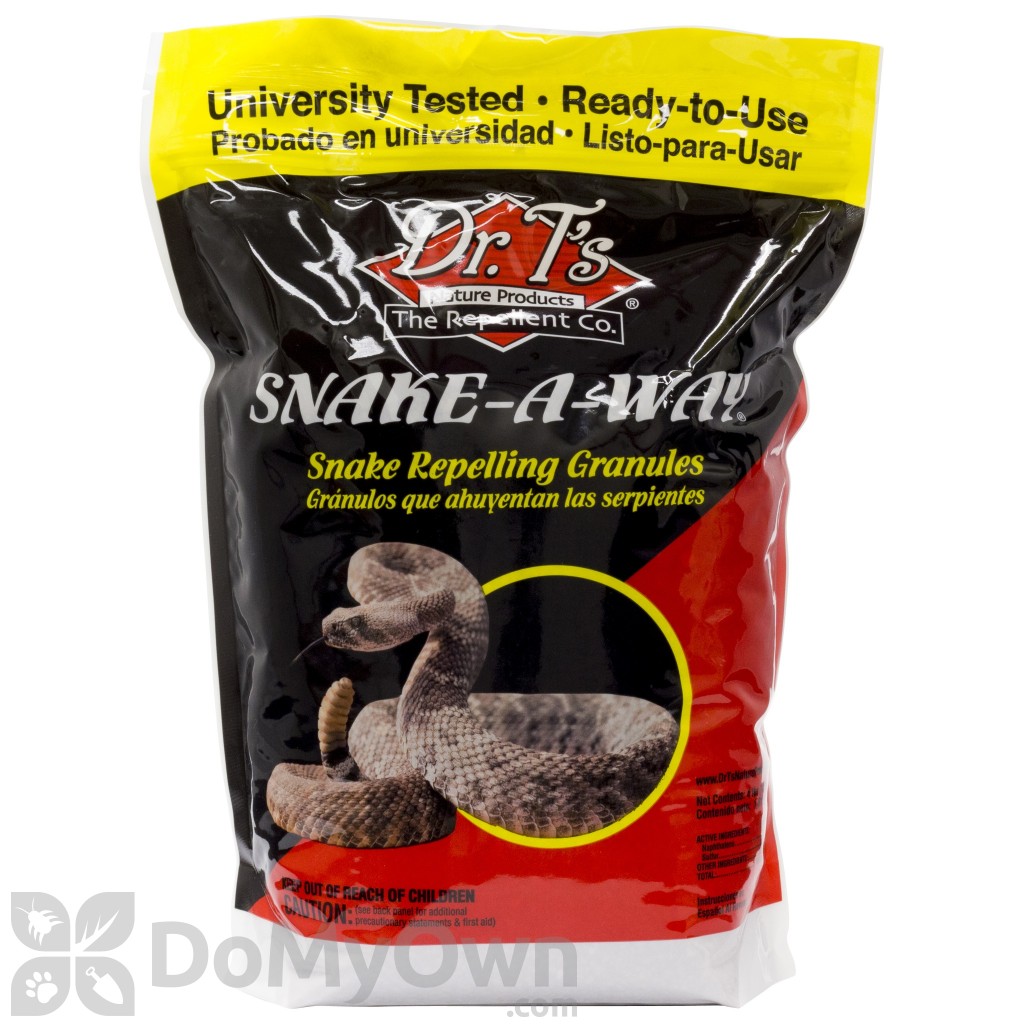
Snake-A-Way is the world’s only EPA registered, university tested, patented snake repellent that will effectively repel both poisonous and non-poisonous snakes. The Snake-A-Way dry granular mixture is easy to apply and can be sprinkled by hand around homes, trailers, cabins, camp sites, and garages, or wherever snakes repellency is desired.
Snake Away is effective for up to 3 months.
Product Documents
| Active Ingredient | Naphthalene 7%, Sulfur 28% |
|---|---|
| Target pests | Snakes |
| For use in | Outdoor Use Only: Houses, Cabins, Trailers, Garages, Utility Houses, Barns, Woodpiles, Sand Piles, Trash Cans and Flower Beds |
| NOT FOR SALE TO | CA |
| Shipping Weight | 2.06 lbs |
| Manufacturer | Dr. T (Mfg. Number: 100001095) |
| UPC | 743860222020 |
| EPA Registration | 58630-1 |
To repel rattlesnakes (Genus Crotalus) and checkered garter (Thamnophis Marcianus) from areas around houses, cabins, trailers, garages, utility houses, barns, woodpiles, sand piles, trash cans, and flower beds. May also be used around the periphery of gardens. Do not use this product at sites where snakes are believed to be already present as the deterrent effects of the product might tend to confine snakes to the treated areas.
Do not apply this product in gardens or in fields of crops grown for food or feed. Do not use this product near streams, ponds, pools, or water supplies.
Tests of this product have suggested that it can be an effective deterrent for the types of snakes listed above.
While the product might deter other types of snakes as well, it is not expected to consistently repel snakes of the following types: corn snakes and other rat snakes (Genus Elaphe); and “moccasin” snakes such as cottonmouths and copperheads (Genus Agkistrodon).
Snake Away Product Features:
How does Snake Away work?
Dr. T's uses knowledge of the snake's Jacobson's organ which controls a snake's sensory reception ability. As Dr. T's Snake-A-Way snake repellent's active ingredient vaporizes, it is brought into the sensory receptor (Jacobson’s organ) of approaching snakes and creates an immediate interference. The result is that the snake’s sensory system temporarily closes down, confounding the snake and scaring it into hasty retreat. This effect is only temporary, and the snake’s sensory functions will return to normal after the snake has retreated far enough away from the treated area.
How to Apply Snake Away:
Testing
Effectiveness test were conducted by Dr. Harvey Lillywhite, Professor of Reptology, University of Florida. Dr. Lillywhite is internationally recognized as one of the worlds leading research reptologists. Over ten years of independent research and follow-up tests were also conducted by Dr. T's Nature Products. Inc. The effectiveness of the repellent is demonstrated by the following experiments performed with various species and the product has been found to have a rate of efficacy that varies from 17% to 100% depending on the individual species.
In as much as the normal behavior of snakes is to move slowly in a deliberate and investigatory manner, the experments were devised to test the snakes responses to the repellent in as near to normal conditions as possible. In use, the granular product is spread on the ground across an area where it is desired to prevent or discourage snakes from entering. Preferably, the granules should be spread in a strip 10-30 centimeters wide, although generally the wider the strip the better. In this manner, an odor barrier is provided that snakes are reluctant to cross. Additionally, a smaller amount of the product may be scattered in a diffuse or non-continous manner just beyond the strip, on the side away from the area to be protected. This added scattering of the repellent serves to lessen the probability of occasional snakes wandering beyond the strip.
After 2 months, a group of 16 snakes was again re-tested. In this test the branches of the Y were reversed, so that the repellent strip was at the branch opposite from that in the previous test. Moreover, the repellent used was five weeks old ( i.e., it had been on the ground outside, but protected from heavy rainfall). Test we conducted as described for the primary test above. Eleven snakes exhibited overt avoidance of the repellent, and four snakes crossed the repellent. Two of the snakes which crossed the repellent exhibited avoidance behavior first, eventually moving across the repellent strip while rubbing the head against the ground, seemingly attempting to escape from the repellent. Repelled snakes showed no hesitation to enter the opposite ( benign ) branch of the Y.
CONCLUSION AND DISCUSSION
The principal conclusions from this study are as follows. (1) SNAKE-A-WAY repels snakes. (2) The efficacy of the repellent varies with taxon: some species are repelled with remarkable effectiveness, while other are not. How ever all species tested exhibit some degree of behavioral avoidance of the repellent. (3) There are circumstances in which individual snakes of all species tested will cross a strip of repellent, so the product cannot be regarded as an absolute barrier to these reptiles. Such situations are expected to be rare in natural environments, however, and (4) Use of the product can be expected to reduce significantly the occurrence of snakes within areas that are to be 'protected" by recommended use of the product. Typical behavior involved jerking the head away from the repellent after approaching it with the tongue flicks, then crawling away, often rubbing the sides of the head along the ground for a brief period. In one case the body of the snake started writhing after contacting the strip of repellent.
These behaviors were common and receptable, and they occured in some individuals as they approached the repellent from distances of 10-15 cm. Four snakes were re-tested two consecutive times, and all repeatedly avoided the repellent. In cases where snakes exhibited avoidance behaviors but nonetheless crossed the repellent strip. In various ways, it seems likely that a diffuse scattering of SNAKE-A-WAY pellets over the area beyond the strip would have caused the snake to eventually leave the area. Such procedure might also enhance the effectiveness of the product on substrates that are coarse-grained or uneven. Considering all the data, the fundemental conclusions regarding efficacy remanin the same. SNAKE-A-WAY should significantly decrease occurances.
Copperheads were strongly repelled by SNAKE-A-WAY, while the related cottonmouths were not. This result is interesting insofar as cottonmouths inhabit swamps and readily feed on carrion. It is possible that the sulforous smell of the repellent is normally encountered by the latter species, either in parts of the natural habitat or during carrion feeding, or both.

This works!
By Rick on 08/24/2018
Live in remote AZ, lots of rattlesnakes! Use this as a barrier around my home and yard, no more snakes. Need to freshen up monthly in summer when snakes are active. Have watched snakes turn up their noses and head back into the desert!
Was this review helpful to you? YesNo
36 of 36 people found this review helpful

Snake away mr t's
By Connie on 06/07/2019
DO NOT BUY IF YOU HAVE PETS
By Sarra on 06/20/2020
Please keep this away from pets. I know it says safe to use around pets but the active ingredient is SUPER toxic to animals. We received this in the mail, closed and in a taped up box. We left it in the garage for a few days. Even while it was closed and taped up, you could still slightly smell the fumes. We didn't think much of it because like it says on the package, it's "safe around pets" so we kept it taped up in the box for a few days. Our amazing 2.5 year old Great Dane started having these nosebleeds. We couldn't figure out what was causing it so we took him to the vet on Thursday, they prescribed Benadryl to see if that would help. Later that evening we also took the Snake-A-Way out of the box and sprinkled some on the otherside of our fence, (with neighbors permission of course), since they don't have pets. EVEN THOUGH it says it is safe around pets we were still careful. It is now Saturday and our wonderful dog had a seizure this morning, pee'd on himself (he has NEVER had an accident in the house), and he couldn't even stand up after going to the bathroom and his legs were kicking. We then had to carry him outside to the car since he couldn't walk and rushed him to the vet. His face was swelling, they took blood, gave fluids, and steroids. This is when we started going over all the things that could've caused this and this is the only thing we could think of thats different. The Vet then had me look up the active ingredients in this stuff and sure enough, its VERY toxic to pets. We then had to take them to another vet 2 towns over to be watched over night. While getting checked in, he's had another seizure and we found out his platelets are very low. Right now we're not sure if he'll make it and this was from a very small "dose" of fumes. Our dog only walks through the garage to get to the yard to go to the bathroom and very rarely might lay in the garage for about 10-15 minutes at a time, but there is always a door open in the garage. Imagine if we had put this stuff directly into our yard and it got soaked up through his paws? My family is still at the vet right now hoping that our dog pulls through. If you have pets, PLEASE do not buy this product.
Was this review helpful to you? YesNo
4 of 5 people found this review helpful

Hate picture on front - taped over!
By Patricia on 05/01/2020
Snake A Way is not harmful to dogs when used and stored as directed, however the odor is very strong and may be harmful if they inhale it. We recommend using this product out of reach of pets, or you may consider a repellent such as Snake Out instead.
Was this answer helpful to you? YesNo
17 of 21 people found this answer helpful
Snake A Way is not harmful to humans if used as directed. Snake A Way uses a variety of natural ingredients designed to irritate the smell and taste and passages of snakes to deter them from the area. Be sure this product is used outdoors only and is stored in an area that is well ventilated and away from children and pets.
Was this answer helpful to you? YesNo
14 of 14 people found this answer helpful
Snake A Way uses knowledge of the snake's Jacobson's organ which controls a snake's sensory reception ability. As Dr. T's Snake-A-Way snake repellent's active ingredient vaporizes, it is brought into the sensory receptor (Jacobson’s organ) of approaching snakes and creates an immediate interference. The result is that the snake’s sensory system temporarily closes down, confounding the snake and scaring it into a hasty retreat. This effect is only temporary, and the snake’s sensory functions will return to normal after the snake has retreated far enough away from the treated area.
Was this answer helpful to you? YesNo
12 of 14 people found this answer helpful
The reviews conflict the back label. Most reviews say it is safe for pets but why does the back label say it is harmful?
Snake A Way is not harmful to pets, although, some may dislike the odor. If you have outdoor pets, then you may consider using a natural snake repellent instead, such as Snake Out Snake Repellent.
Snake A Way
 Rating: 2.5 (4 Reviews / 4 Q&A)